
The headlines scream about AI taking everyone's jobs. Tech CEOs promise utopia. Wall Street analysts spin rosy narratives about "job creation" and "transformation." But here's what they're not telling you: the job apocalypse isn't coming—it's already here, and it's eating Gen Z alive.
While everyone was busy worrying about truck drivers and factory workers, AI quietly pulled up a chair at the coding desk. And it brought an appetite.
The Numbers Don't Lie (But Everyone Else Does)
Let's cut through the corporate doublespeak. In May 2023 alone, 3,900 U.S. jobs were directly attributed to AI—making it the seventh-largest job killer that month. Since 2023, we're looking at roughly 27,000 jobs directly wiped out by artificial intelligence. That's not a rounding error. That's a small city's worth of livelihoods.
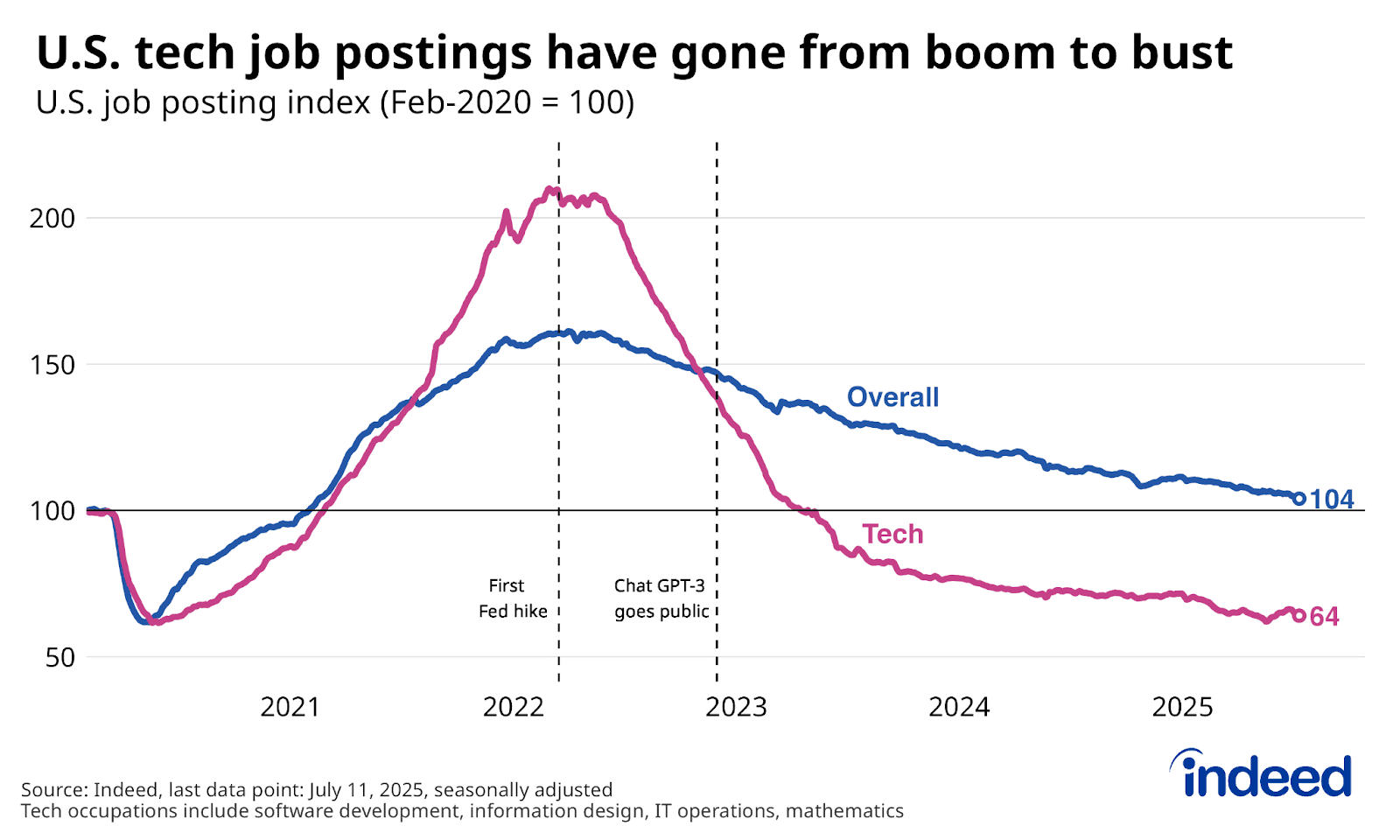
But here's where it gets interesting: this isn't hitting where the pundits predicted. Blue-collar workers? Still largely employed. Factory floors? Surprisingly resilient. The real carnage is happening in cubicles and home offices, where fresh-faced college grads thought they'd found their ticket to the middle class.
Entry-level tech unemployment just hit 5.8%—the highest in four years. Computer science graduates are posting 6.1% unemployment rates, while computer engineering grads are even worse at 7.5%. Want to know what's really twisted? Art history majors are doing better at 3%. Philosophy grads? 3.2%. Even journalism majors—journalism!—are sitting prettier at 4.4%.
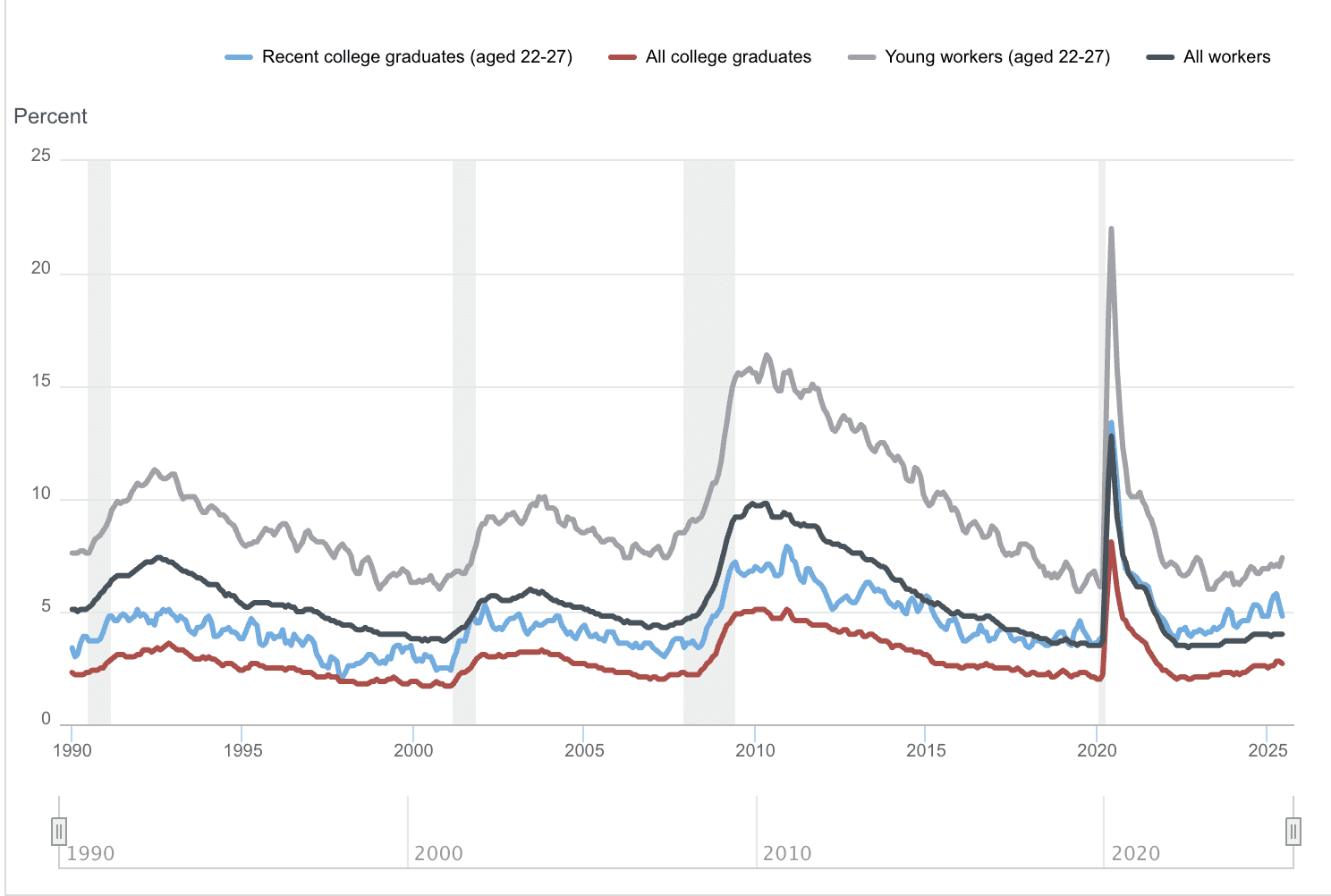
The "learn to code" meme didn't just die. It got automated.
The Invisible Hand Is Now Made of Silicon
Here's what's actually happening on the ground, away from the sanitized press releases:
Entry-level hiring at Big Tech companies dropped 50% compared to pre-pandemic levels
Startups slashed junior developer hiring by 30% over the same period
Job postings for entry-level software engineers fell 71% between February 2022 and August 2025
Even elite engineering grads saw employment drop from 80% to 70% by 2024
Meanwhile, 37% of companies using AI admitted they replaced workers in 2023 because "they were no longer needed." And for 2024? 44% said layoffs due to AI were either "definite" or "probable."
This isn't creative destruction. It's just destruction with better marketing.
The GenZ Squeeze: Trained for Jobs That No Longer Exist
Picture this: You're 22. You just spent four years and maybe $200,000 learning to code. You were told this was the golden ticket. The safe bet. The future.
Then you graduate into a market where 58% of recent grads are still hunting for their first full-time job, compared to just 25% of older generations at the same stage. You're competing against not just other humans, but against GitHub Copilot, which costs $10 per month while you need $90,000 per year just to make rent in any tech hub.
One CS grad applied to 5,762 jobs without landing a single full-time offer. That's not an outlier anymore—that's the new normal. Gen Z workers in tech now make up just 6.8% of workforces at major companies, down from 15% in January 2023. The average age at tech companies jumped from 34.3 years to 39.4 years in just two and a half years.
They're not building teams anymore. They're building AI oversight committees staffed by expensive veterans.
Senior Devs Build the Guillotine, Junior Devs Line Up
Here's the really dark irony: senior developers are using AI tools to get 30% productivity boosts, which sounds great until you realize what "productivity" means in this context—doing the work of three people, including the two juniors who would have been hired.
Salesforce CEO Marc Benioff announced in December 2024 that his company would not hire any more software engineers in 2025 thanks to that AI-driven productivity bump. Facebook's Mark Zuckerberg suggested similar moves. These aren't random CEOs at struggling startups—these are the giants that used to be talent magnets for fresh graduates.
One senior developer put it bluntly: "In a straightforward competition between a junior engineer and an AI, the AI will probably produce better code." Another was more honest about what this means long-term: "Companies say 'We don't want to hire juniors, we only want these high-end mid to seniors,' but then the problem with that is in 5-10 years time, there will be none of the experience at the lower end."
They're eating their seed corn. But quarterly earnings don't care about 2030's talent pipeline.
The Catch-22 From Hell
Want to know the real kicker? Entry-level job postings now routinely ask for 2-5 years of experience. Not the old "1-2 years preferred" that everyone ignored. Real requirements. Hard stops in the applicant tracking systems.
But how do you get experience when internships across all industries dropped 11%, and tech-specific internships plummeted 30% since 2023? When 70% of hiring managers believe AI can do the job of interns? When 57% trust AI's work more than that of recent grads?
You can't. That's the point. The ladder's been pulled up, and the people at the top are telling you to "learn to work with AI" as if that solves the fundamental problem that nobody will give you a chance to learn anything at all.
The Geography of Despair
This isn't evenly distributed either. Goldman Sachs economist Joseph Briggs noted that unemployment for 20-30 year olds in tech increased by about 3% in early 2025—a "much larger increase" than in tech broadly or among young workers in other sectors.
IT unemployment jumped from 3.9% to 5.7% between December 2024 and January 2025, with 152,000 unemployed IT professionals. The tech job market shed 171,000 positions over 24 months. That's not a correction—that's a restructuring.
And here's the demographic twist: 9.1% of Gen Z men aged 20-24 were jobless in Q2 2025, compared to just 7.2% of women. Why? Because the jobs getting automated—coding, financial analysis, technical support—skew male, while healthcare roles that resist automation skew female.
What They're Not Telling You
The narrative you'll hear from Silicon Valley is that AI creates more jobs than it destroys. They'll point to AI specialists, data architects, and machine learning engineers seeing 40% growth projections. They'll mention database architect postings up 2,140%.
What they won't mention is that these aren't entry-level jobs. You can't go from zero to AI architect. You need years of experience—the exact experience that junior roles used to provide but no longer exist to give you.
A recent survey found 97% of developers are using AI coding tools. GitHub Copilot alone has 1.3 million users. These tools are genuinely useful—for people who already know how to code. For people who understand when the AI is spouting nonsense. For people who have the pattern recognition that comes from years of making mistakes.
They're a force multiplier for the employed. They're a barrier to entry for everyone else.
The Uncomfortable Truth Nobody Wants to Say
Here it is: We're creating a technological aristocracy.
If you're already in, if you have 5+ years of experience, if you're senior enough to "orchestrate AI tools," you're golden. Demand for senior developers is actually increasing. Your salary's going up. Your job security is solid. You're the human in the loop, the one with judgment, the adult supervision for the algorithmic children.
But if you're trying to break in? You're locked out. The bridge is up. The portcullis is down. And the people inside are saying "just be better" while the moat fills with AI-generated code that's "good enough" for the work you would have done.
4.3 million young people are now NEETs—not in education, employment, or training. That number's growing. And unlike past recessions where people could retrain or wait it out, this feels permanent. The jobs aren't coming back because they've been coded away.
What Comes Next Isn't Pretty
The optimists will tell you this is just a transition period. That new roles will emerge. That Gen Z will adapt. That this is no different than when computers replaced typists or email replaced mail rooms.
They're wrong.
Those transitions happened over decades. This one's happening in months. Employment for software developers aged 22-25 declined nearly 20% from late 2022 to mid-2025—less than three years. That's not a transition. That's a cliff.
And unlike previous technology shifts that primarily affected blue-collar workers, this one's hitting the educated class. The people who did everything "right." Who went to good schools, learned valuable skills, accrued massive debt based on promises about the future. Those promises are being broken in real-time, and the social contract along with them.
When the people who were supposed to be the winners in the knowledge economy find themselves locked out, what happens? History suggests it doesn't end with everyone retraining to become AI prompt engineers.
The Bottom Line
AI isn't destroying all jobs. It's not the robot apocalypse the think pieces warned about. It's something more surgical and, in some ways, more cruel: it's eliminating the first rung on the ladder while leaving the top rungs alone.
Senior developers are doing fine—great, even. Mid-level folks are nervous but hanging on. And everyone entering the field is discovering that the door's been bricked shut while they were studying.
Global entry-level job postings have fallen 29 percentage points since January 2024. That's not a trend—that's an extinction event for a certain kind of career path. And it's happening while tech companies post record profits, while AI companies raise billions, while the stock market soars.
The job apocalypse is here. It's just not evenly distributed yet. But give it time—automation has a way of climbing the ladder once it gets started.
Welcome to the future. It's efficient, it's profitable, and it doesn't need you.
NEVER MISS A THING!
Subscribe and get freshly baked articles. Join the community!
Join the newsletter to receive the latest updates in your inbox.