
Profit-Taking as Strategy, Not Panic: The Art of Timing Your Exit From a Bubble
Most investors spend years refining their entry strategy. They study charts, track sentiment, build watchlists, and wait patiently for the right moment to deploy capital. Yet ask those same investors about their exit strategy and you'll often be met with something vague — "I'll know when it's time," or worse, "I'm a long-term investor, I don't time the market."
That philosophy works well enough in normal markets. In a bubble, it's quietly catastrophic.
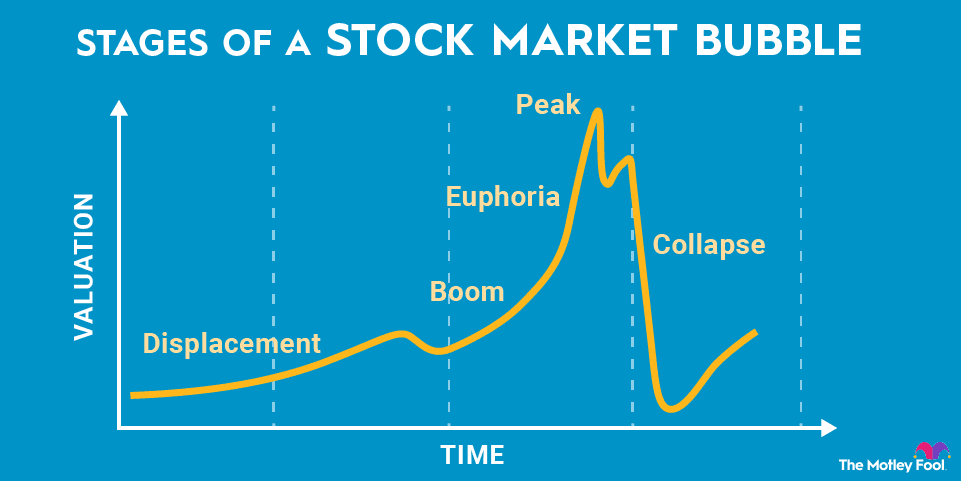
Bubble cycles don't follow the rules of ordinary bull markets. When prices go parabolic — rising 40%, 50%, or more in compressed timeframes — the eventual mean reversion is equally violent. The investors who rode the dot-com wave to its peak in March 2000 and held on "for the long term" spent the next two and a half years watching the NASDAQ fall 78%. Many never recovered their losses. The tragedy wasn't that they failed to see the bubble. Most of them knew something was off. The tragedy was that they had no framework for acting on that knowledge.
Profit-taking during a bubble isn't panic. It isn't pessimism. Done with discipline and forethought, it is the single most strategic decision an investor can make — and the one most consistently avoided.
Reading the Room: When Heating Up Becomes Maxed Out
The most common mistake investors make in a bubble is confusing early warning signs for terminal ones. Bubble warnings tend to arrive long before the peak. In fact, widespread fear of a bubble — analysts sounding alarms, financial media running cautionary headlines, prominent voices calling for exits — is historically one of the clearest signs that a rally still has room to run. Bearish sentiment at elevated price levels is fuel, not a red flag. The contrarian investor's instinct is to fade these early warnings, stay invested, and let the crowd's anxiety do the work.
The question isn't whether a bubble exists. It's whether it's done.
What a Bubble Exhaustion Actually Looks Like
No single indicator reliably marks a bubble's exhaustion point, but a convergence of signals arriving simultaneously deserves serious attention. Here's what that convergence tends to look like in practice:
Sentiment flips from fear to euphoria. The last skeptic capitulates. The narrative shifts from "this can't last" to "this time is different."
Price acceleration intensifies. In a parabolic move, the rate of gains is itself accelerating — not just the gains. The curve steepens visibly.
Media framing changes character. Headlines stop asking "is this a bubble?" and start asking "how high can it go?" That shift in tone is a reliable late-stage signal.
Retail money floods in. Early rallies are driven by informed, conviction-based buying. Late-stage bubbles attract reactive, momentum-chasing, often leveraged capital. When unsophisticated buyers dominate inflows, the pool of greater fools is nearly exhausted.
Hedging activity collapses. Record speculative positioning combined with collapsing put buying mirrors — in reverse — the sentiment conditions that launched the rally in the first place.
When three or more of these signals arrive together, the risk profile of holding has changed fundamentally, whether or not prices have peaked yet.
The Exit Framework: Selling With a Plan, Not an Emotion
Knowing that you should sell is far easier than knowing how. The psychology of exiting a winning position is genuinely difficult. Selling into strength feels wrong — even reckless. Prices are rising, momentum is powerful, and every day you stay invested seems to validate the decision to hold. The market has a way of making patience feel like wisdom right up until it doesn't.
This is why a rules-based, staged exit framework matters more than any individual forecast.
Rather than attempting to identify the precise top — a fool's errand even for experienced investors — the goal is incremental reduction as signals accumulate. Trim 10% to 15% of your position when the first cluster of warning signs appears. Trim again when a second cluster follows. By the time a clear top is confirmed in hindsight, you've already captured the majority of your gains and dramatically reduced your exposure to the downside.
This approach carries a liberating implication: you don't need to be right about the exact peak. You only need to be directionally correct, and early enough to act before the exit becomes crowded.
The goal is never to sell at the top. The goal is to sell near the top, with most of your gains intact. Leaving some profit on the table is not a failure of strategy. It is, in fact, proof that the strategy worked — because it means you didn't stay for the crash.
The investors who survive bubbles aren't the ones who called the peak perfectly. They're the ones who had a plan, trusted it, and acted before panic made the decision for them.
Put This Into Practice: A Strategy Built for Markets Like This
Reading about bubble dynamics is one thing. Having a systematic, rules-based strategy that actually responds to momentum in real time is another.
If this article resonated with you, consider what it means in practice: the investors who thrive in parabolic markets aren't just the ones who understand sentiment cycles — they're the ones whose portfolio mechanics are built to capture momentum while it lasts, and adapt when conditions shift.
That's exactly what the RSI-Weighted ETFs strategy on Surmount is designed to do.
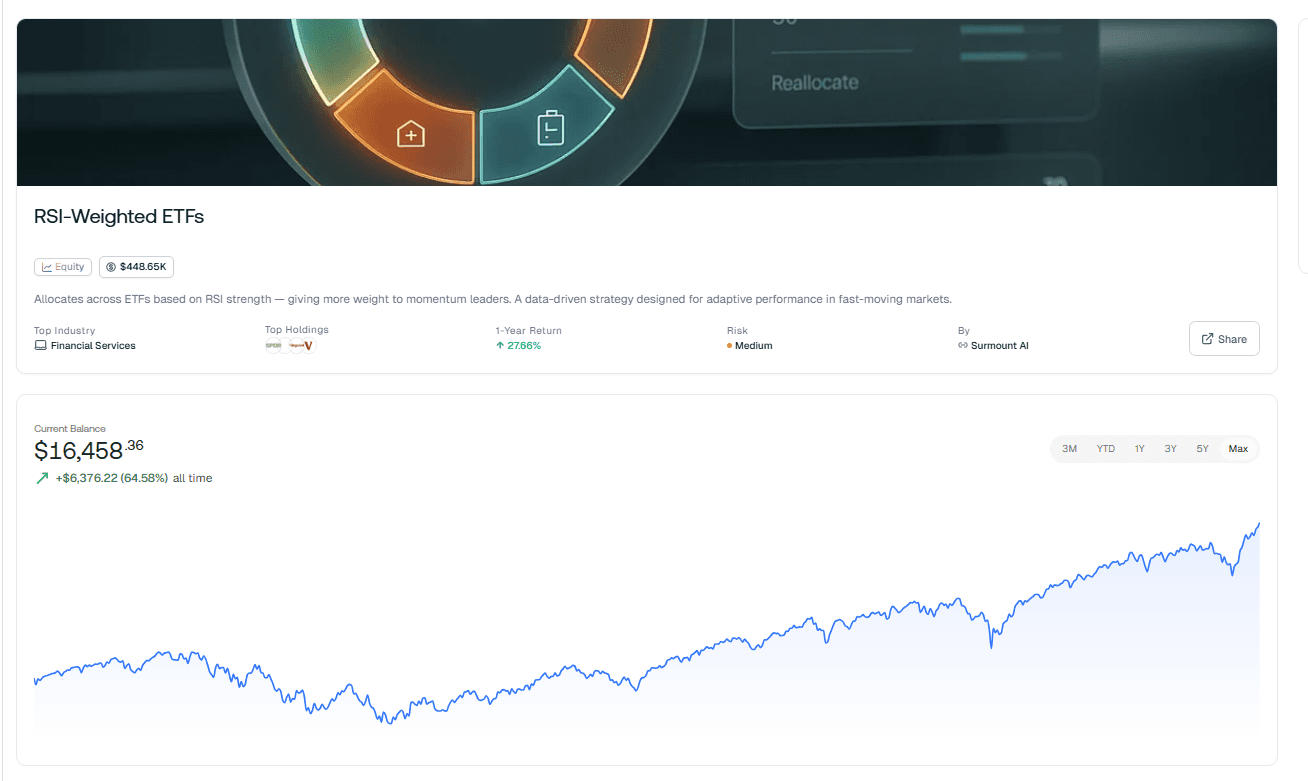
Rather than relying on gut feel or static allocations, this automated strategy uses the Relative Strength Index (RSI) — one of the most battle-tested momentum indicators in technical analysis — to dynamically weight your portfolio toward the ETFs showing the greatest relative strength at any given time. The stronger the momentum, the greater the allocation. It's not chasing noise. It's systematically following signal.
Why This Strategy Makes Sense Right Now
Everything discussed in this article points to the same underlying truth: in a late-stage momentum market, the winners tend to keep winning — until they don't. The RSI-Weighted ETFs strategy is built precisely for this environment. It leans into strength while it persists, and rebalances as the picture changes. No emotion. No hesitation. No freezing at the top.
This is the mechanical embodiment of the contrarian investor's ideal: data-driven conviction, without the psychological baggage.
What You Get
Automated execution — the strategy runs without you needing to monitor markets daily
Adaptive allocation — portfolio weights shift as RSI values evolve, keeping you aligned with momentum leaders
ETF diversification — broad exposure across asset classes, weighted toward what's actually working
Discipline by design — removes the temptation to override your strategy at exactly the wrong moment
For investors watching a potential parabolic move unfold in real time, the worst outcome isn't missing the rally. It's being positioned too passively to benefit from it, or too emotionally to exit when the signals turn.
The RSI-Weighted ETFs strategy gives you a systematic edge at both ends of that equation.
👉 Explore the RSI-Weighted ETFs strategy on Surmount and start putting momentum to work in your portfolio.
NEVER MISS A THING!
Subscribe and get freshly baked articles. Join the community!
Join the newsletter to receive the latest updates in your inbox.