
Rising Bond Yields: What It Means for Your Stock Market
When bond yields rise sharply, most investors feel the turbulence but struggle to explain it. They watch their portfolios shift, hear conflicting narratives on financial media, and make reactive decisions based on incomplete frameworks. Sophisticated investors do the opposite — they understand the mechanism, read the signals early, and position ahead of the crowd.
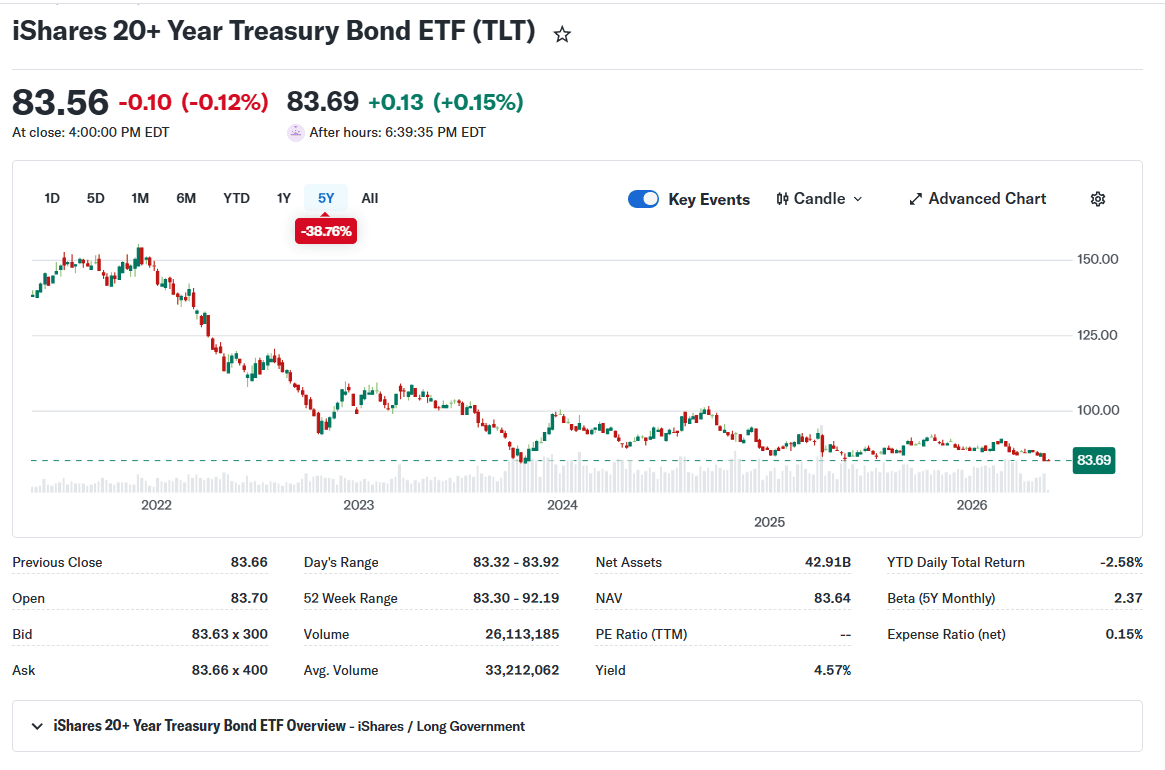
Right now, the bond market is flashing warnings that deserve serious attention. The iShares 20+ Year Treasury Bond Fund (TLT) has dropped to its lowest levels since 2023, signaling that long-term rates are climbing with conviction. This is not noise. For equity investors, this changes the rules of engagement.
The Bond-Equity Relationship Most Investors Misunderstand
At its core, rising bond yields make bonds more attractive relative to equities. When the risk-free rate goes up, the discount rate applied to future corporate earnings goes up with it. That mechanically compresses equity valuations — especially for growth stocks whose value is weighted heavily toward earnings years into the future, a dynamic index investors are increasingly exposed to without realizing it.
But the misunderstanding runs deeper than valuation math. Many investors treat bonds and equities as separate conversations. They are not. The bond market is the largest, most liquid financial market in the world, and it prices risk with a precision that the equity market routinely lags. When the bond market moves decisively, equities follow — the only question is timing.
What History Tells Us About Rising Interest Rates and Investment Strategy
History offers a clear pattern for investors willing to look. In 1994, the Federal Reserve raised rates aggressively and caught equity markets off guard — the S&P 500 ended the year flat despite a strong economy. In 2013, the mere suggestion of tapering bond purchases triggered the "taper tantrum," sending yields surging and growth stocks into a sharp correction. Most recently, 2022 saw one of the most aggressive rate-hiking cycles in decades, producing the worst year for the traditional 60/40 portfolio in a generation.
Each episode shared a common dynamic: The investors who recognized the bond market signal early repositioned into value, dividend-paying stocks, and rate-resilient sectors before the broader market caught up — a discipline closer to strategic profit-taking than panic.
The contrarian edge has consistently lived in that gap between the signal and the crowd's reaction.
How Rising Bond Yields Affect Your Equity Portfolio Today
The current environment mirrors several of those historical warning periods. Long-term yields are rising, the TLT is near multi-year lows, and equity market breadth is deteriorating beneath the surface — even as headline indices hold near highs. That divergence is a critical tell.
For a high-net-worth equity investor, rising yields create three distinct pressures: they increase borrowing costs for companies with heavy debt loads, they raise the hurdle rate for capital allocation decisions, and they pull institutional money toward fixed income for the first time in years. Each pressure takes time to fully transmit through earnings, which is exactly why early positioning matters.
Rate-Sensitive Sectors to Avoid Right Now
Utilities, real estate investment trusts (REITs), and highly leveraged consumer discretionary companies are the most exposed. These sectors are effectively priced like long-duration bonds — their appeal rests on stable, yield-like returns that become less competitive as the risk-free rate climbs. Investors rotating out of these sectors in a rising rate environment are not panicking. They are being rational.
Best Sectors in a Rising Rate Environment
Financials — particularly banks — tend to benefit from rising rates as net interest margins expand. Energy, defense, and select industrial companies with strong pricing power also tend to hold up well. Value stocks with low price-to-earnings ratios and strong cash flows outperform growth in virtually every documented rising rate cycle — and as we've covered separately, certain defensive sectors tend to thrive even when broader conditions deteriorate.
Sector Rotation Strategy When Bond Yields Rise
Sector rotation in a rising rate environment is not guesswork — it follows a repeatable logic. Capital flows away from duration-sensitive, speculative, and debt-heavy sectors toward cash-generative, asset-backed, and cyclically resilient ones. Tracking the momentum of sector fund flows gives you a reliable early signal of where institutional money is moving before the price fully reflects it.
A disciplined rotation strategy also accounts for duration risk across your portfolio — not just in bonds but embedded within high-multiple equity positions. Growth stocks trading at 40 or 50 times earnings carry significant duration risk that investors rarely calculate explicitly. In a rising rate environment, that risk gets repriced fast.
What the Bond Market Warning Signals Are Saying in 2025
The bond market is currently pricing in a sustained period of elevated rates. The TLT decline is not a brief technical dip — it reflects persistent selling pressure from investors who no longer believe rates are headed materially lower in the near term. For equity investors, this matters because it removes one of the key tailwinds that drove the 2023 and 2024 bull markets: the expectation of imminent rate cuts.
The contrarian read here is not simply bearish. It is selective — and it starts with recognizing the warning signs that markets are pricing in too much optimism at precisely the wrong moment in the cycle.
Markets historically deliver positive returns even in rising rate environments — the distribution of those returns just shifts dramatically between sectors. The investors who thrive are those who rotate with the signal rather than holding static positions and hoping the macro reverses.
Why Automated Investing in a Rising Rate Environment Makes Sense
The challenge with macro-driven investing is execution. You can have the right thesis and still leave gains on the table — or absorb unnecessary losses — because human decision-making is slow, emotional, and inconsistent under pressure. Watching a position decline while waiting for conviction to act is one of the most costly behavioral patterns in investing.
This is exactly where automation changes the equation. Algorithmic strategies that are designed to respond to macro signals — yield movements, sector momentum shifts, fund flow changes — execute without hesitation and without the emotional drag that costs discretionary investors performance at precisely the wrong moments.
How to Protect and Grow Your Portfolio When Yields Rise
Three principles hold up consistently across rising rate cycles. First, reduce exposure to high-duration equity positions — growth stocks with distant earnings and leveraged companies with variable-rate debt. Second, rotate toward value, financials, and sectors with hard asset backing. Third, treat the bond market as your leading indicator, not a lagging one — when TLT breaks down, adjust equity positioning before the equity market fully prices in the implication.
The investors who implement these principles systematically, rather than reactively, consistently outperform through rate cycles.
How to Position for It: AlphaFactory Protective
Knowing what the bond market is signaling is one thing. Having a strategy purpose-built to navigate it is another entirely.
AlphaFactory Protective is an automated strategy on Surmount AI that was designed for exactly this kind of environment. It runs a high-conviction basket of the top large-cap stocks from the NASDAQ and NYSE — the kind of fundamentally sound, cash-generating businesses that hold up when rates rise and weaker companies get repriced. But what makes it genuinely different is the risk architecture underneath.
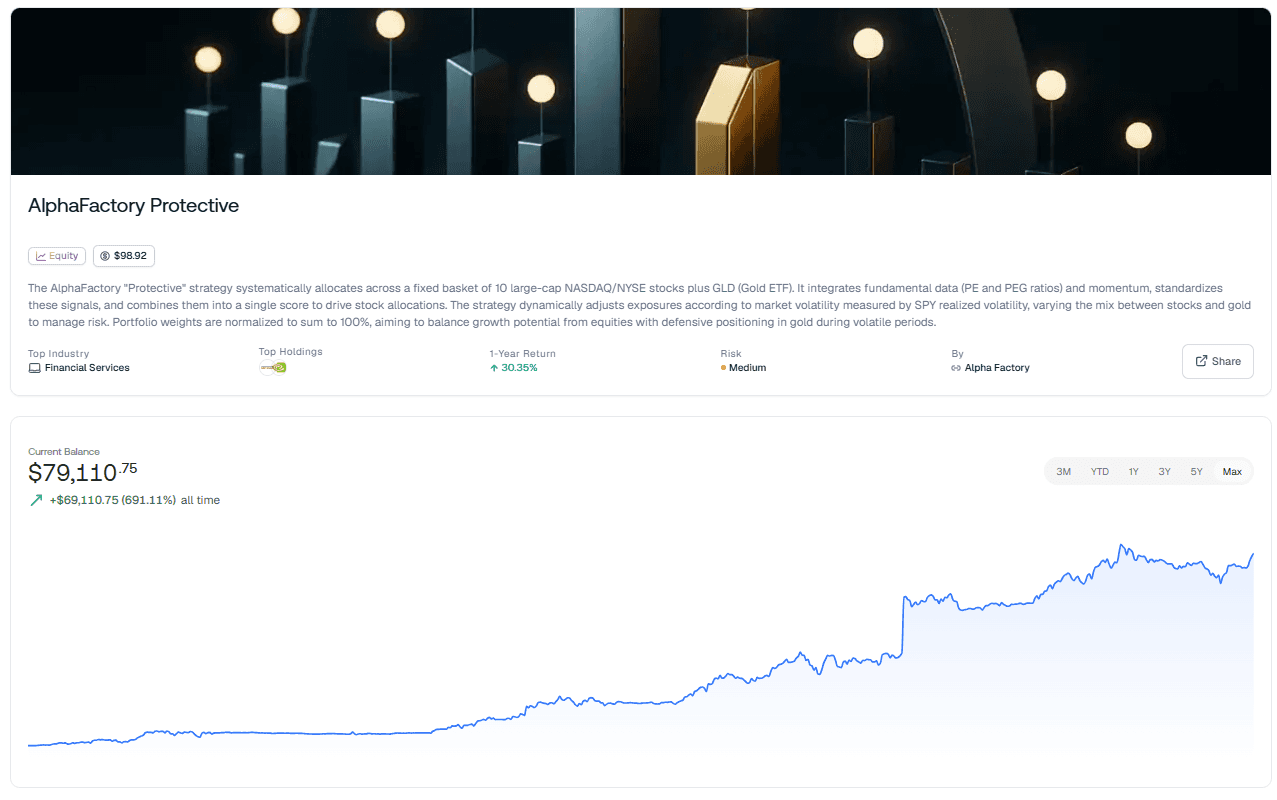
The strategy combines two factors that matter most in a rising rate environment: momentum — which stocks are actually performing, not just which ones look cheap on paper — and value, measured through PEG ratios that filter out the overpriced growth names most vulnerable to yield compression. Those two scores are blended and ranked, so the portfolio is always tilted toward the highest-conviction positions at any given moment.
The protective mechanism is where it gets compelling. AlphaFactory Protective monitors realized market volatility in real time using SPY as its gauge. When volatility is low, it runs full equity allocation. When volatility rises to moderate levels — the kind of choppy, uncertain environment rising rate cycles routinely produce — it automatically rotates a portion of the portfolio into GLD, the Gold ETF, a classic store of value that has historically held up well when real rates are climbing and equity risk premiums are being repriced. When volatility spikes to high levels, it steps out of equities entirely and moves to safety. No emotion. No hesitation. No watching your portfolio bleed while you debate whether to act.
This is precisely the playbook that experienced macro investors run manually — rotate toward quality and value, use gold as a volatility hedge, reduce risk exposure dynamically as conditions deteriorate. AlphaFactory Protective runs that playbook for you, automatically, around the clock.
If the analysis in this piece resonates with you — if you believe bond yields are signaling something serious and that the next phase of this market rewards disciplined, macro-aware positioning — this strategy was built for that conviction.
Deploy AlphaFactory Protective to Your Portfolio →
Frequently Asked Questions
What do rising bond yields mean for the stock market?
Rising bond yields increase the discount rate applied to future earnings, which compresses equity valuations — especially for high-growth stocks. It signals that investors should rotate toward value-oriented, cash-generating companies and away from speculative positions.
How do rising interest rates affect my investment strategy?
Rising rates shift the advantage from growth and momentum stocks toward value stocks, financials, and hard-asset sectors. Investors who adapt their strategy early — rather than reactively — consistently outperform through rate cycles.
Why is sector rotation important when bond yields rise?
Because rising yields don't hurt all sectors equally — financials and energy tend to benefit while REITs, utilities, and leveraged companies get hit hardest. Rotating toward rate-resilient sectors before the broader market reprices is where the contrarian edge lives.
When should I adjust my equity portfolio in a rising rate environment?
The bond market typically leads the equity market, so the time to adjust is when long-term yield signals — like a sustained TLT breakdown — begin, not after equity prices have already fallen. Early positioning is what separates disciplined investors from reactive ones.
NEVER MISS A THING!
Subscribe and get freshly baked articles. Join the community!
Join the newsletter to receive the latest updates in your inbox.