

The "Stone Age" Discount: Why Trump’s Iran Rhetoric is a Generational Buy Signal
With the almost apocalyptic rhetoric currently dominating the airwaves, it’s easy to feel like we are one headline away from a third world war. President Trump’s recent warning that Iran could be bombed “back to the stone ages” and the threat of simultaneous strikes on their power grid is the kind of language that usually sends investors sprinting for the safety of gold bars and bunkers.
Most of CNN’s sentiment indicators currently show an ‘extreme fear’ rating, with the Fear & Greed Index cratering to a 19 as of this week, down from 25 last month.
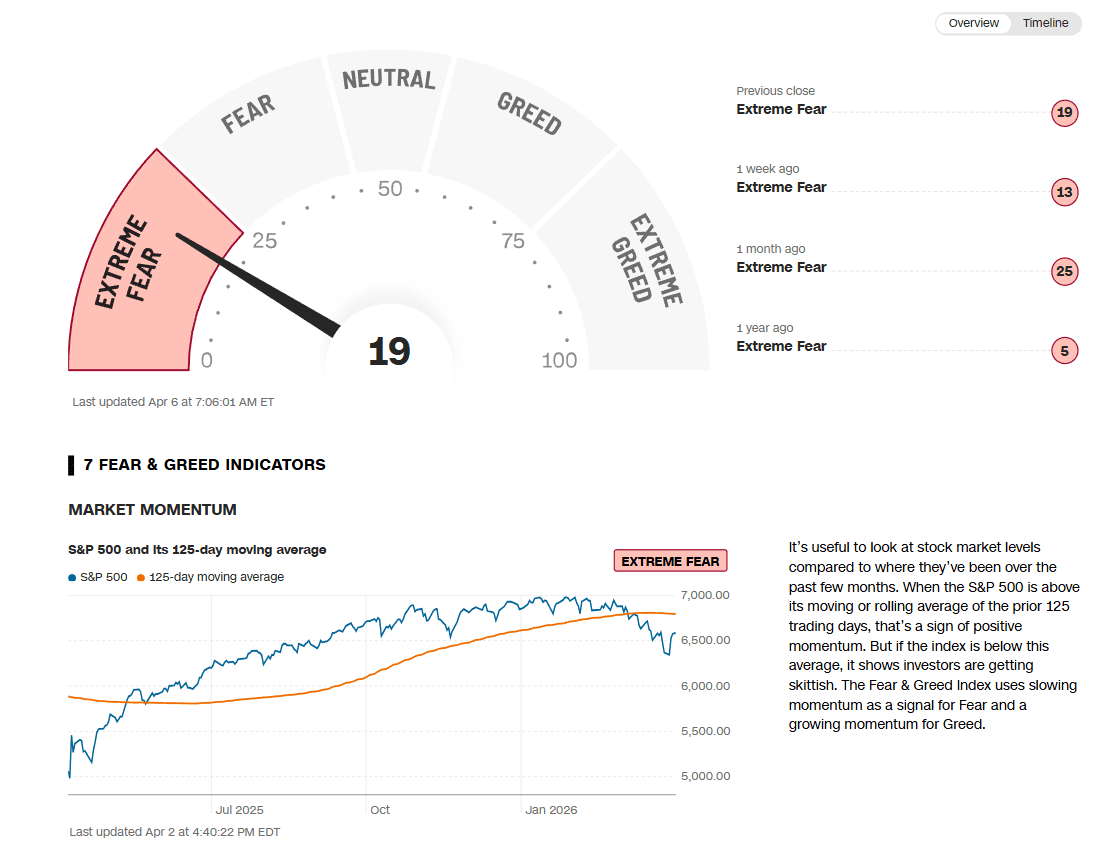
Six out of the seven underlying metrics are screaming red, and panic, is understandably the dominant emotion in the market.
To the average retail investor, the sky is falling. But to the contrarian, this is where things start becoming interesting.
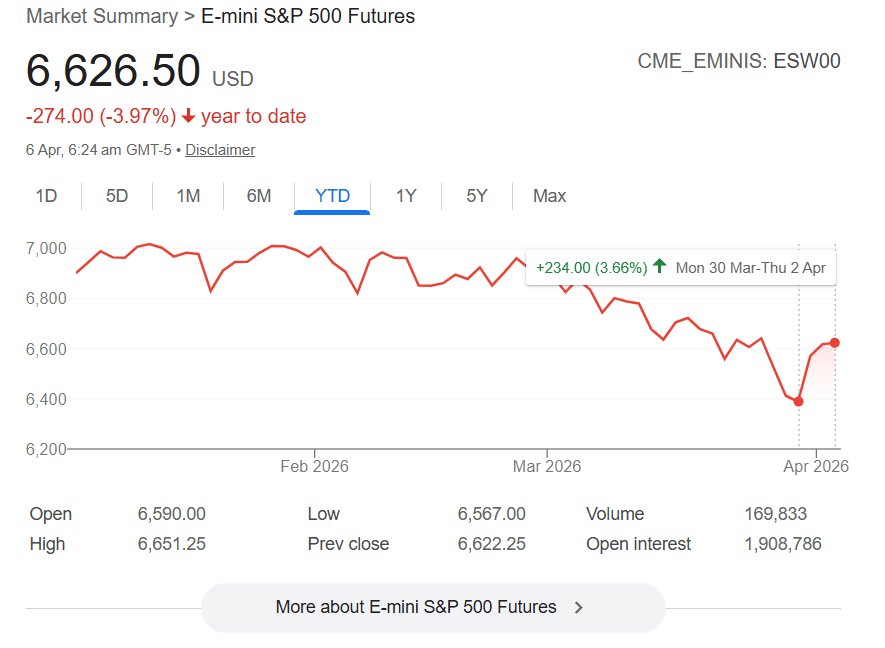
History is a ruthless teacher, and it tells us that the market doesn’t actually fear "bad news", it fears uncertainty. We are currently in what I like to call a "second-moment shock." This is from the S&P 500 futures are trading at a technically critical level.
Interestingly enough, however, while the President is promising "Power Plant Day" and "Bridge Day" on social media, he is simultaneously noting that "discussions are ongoing."
The mainstream is fixated on the threat of the Strait of Hormuz being closed forever. I’m looking at the ISM Manufacturing Index, which just hit a multi-year high of 52.7 despite the war headlines.
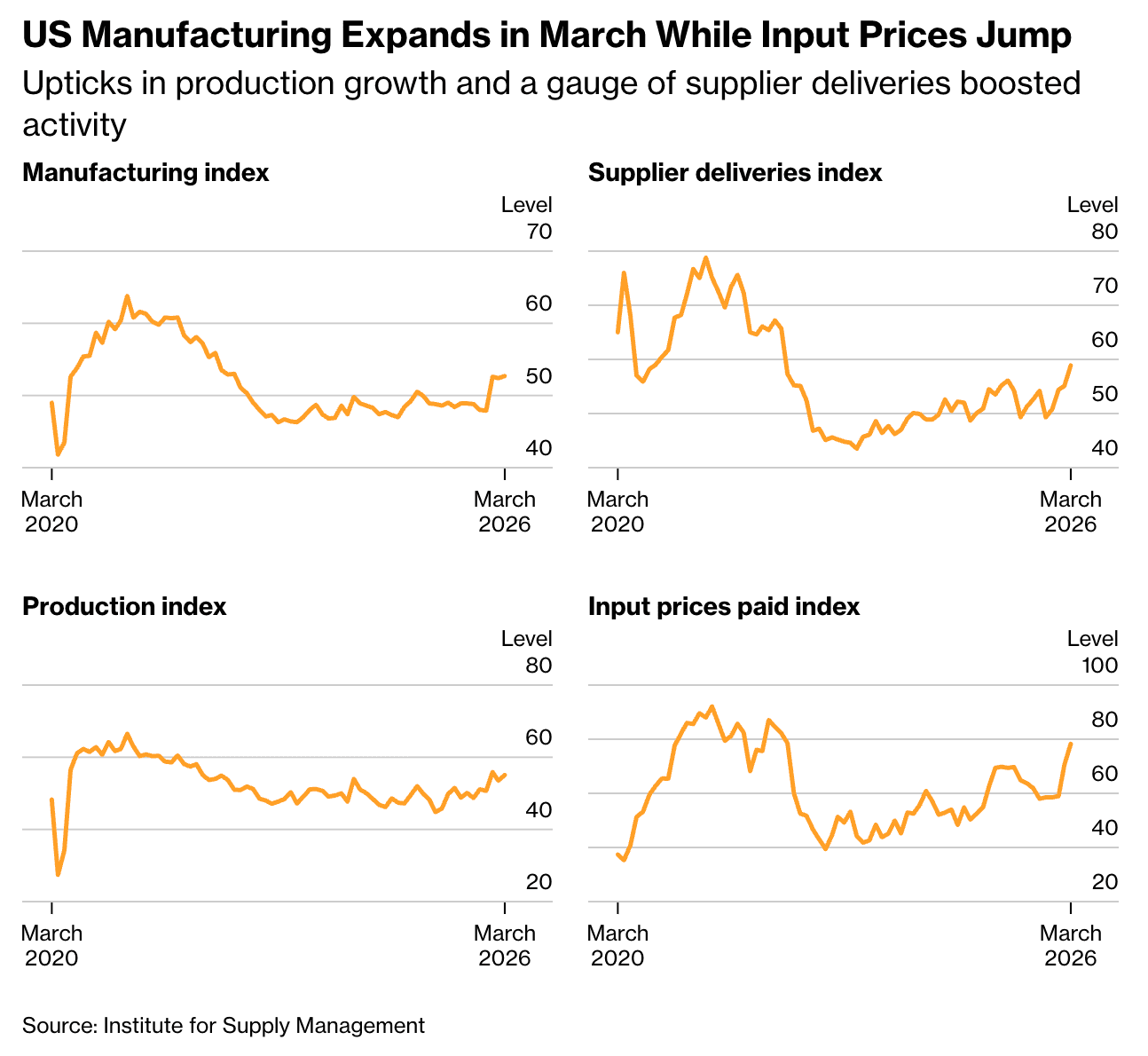
While the talking heads discuss the "Stone Age," American machinery and construction orders are actually increasing. We aren't seeing a systemic collapse; we are seeing a high-stakes negotiation played out in real-time, and the market is providing us a discount to bet on the eventual (and inevitable) de-escalation.
Arbitraging the "Binary" Outcome
The standard market playbook suggests that in a "binary" environment, the only rational move is to sit on the sidelines and wait for clarity. After all, when the difference between the bull and bear case is a single geopolitical spark in the Strait of Hormuz, the "risk-adjusted" move feels like preservation.
But for the more contrarian of us, clarity is the enemy of profit. By the time the binary is resolved, the alpha is all but gone.
To understand why this "Stone Age" rhetoric is a generational entry point, we have to look at the two paths ahead and realize that, under the hood, the "bad" outcome isn't as catastrophic for U.S. cyclicals as the bears claim.
Scenario A: The "January Redux" (De-escalation)
If diplomacy wins or the escalation proves to be more bark than bite, the market will pivot back to the growth acceleration thesis that dominated Q1. In this scenario, the recent 4% "correction" in futures is nothing more than a coiled spring. The top-heavy nature of the S&P 500 has acted as a shield, but the real explosion will happen in the "ignored" cyclicals.
When the threat of a $150 oil shock vanishes, companies like Union Pacific (UNP) and Old Dominion Freight Line (ODFL) (the literal circulatory system of the American economy) will re-rate instantly.
Buying into this could pay off well exceptionally, if this scenario were to play out. Especially if a path towards a robust, pre-war industrial expansion becomes clear.
Scenario B: The "Quiet QE" Hedge (Escalation & Inflation)
This is the outcome that keeps Wall Street awake at night: prolonged war, supply chain chaos, and inflation spiking to 4% or higher.
The consensus view is that this triggers "demand destruction" and a brutal recession.
I disagree.
We are currently witnessing a historic shift where the U.S. government is effectively "running the economy hot" just to devalue its debt and fast-track re-shoring. In this environment, inflation is actually the "lube" for the nominal economic engine. If we enter a period of sustained high energy prices, it won't break the U.S. the way it breaks emerging markets. Instead, it serves as a massive barrier to entry for our global competitors and a catalyst for domestic infrastructure.
Even in a "high-inflation escalation" scenario, the winners are the same:
Asset Managers: Who thrive on navigating complex, high-yield environments.
Infrastructure & Housing: Which remain under-supplied regardless of the headline CPI.
Resilient Tech: Which uses AI to protect margins even as input costs rise.
The arbitrage here is actually pretty simple. The market is pricing Scenario B as a total loss. Pricing Scenario B as a "pivot to domestic dominance", however, makes much more sense.
Either way, the current discount on high-quality cyclical value is a gift.
If you’re still holding 2% yielding T-bills when the market realizes the "Stone Age" was just a headline, things could become really costly.
The "Main Street" Execution: Automating the Infrastructure Supercycle
If you agree that the "Stone Age" rhetoric is a smokescreen for a massive domestic build-out, then you understand that the lube for this new economic engine isn't just oil—it’s data. While the headlines fight over the Strait of Hormuz, the real "Quiet QE" is flowing directly into the digital nervous system of the American economy.
To capture this "Alpha" without getting sidelined by daily volatility, I am highlighting a specific tool for the sophisticated contrarian: the Next-Gen Data Infrastructure strategy on Surmount.
Why This is the "Generational Buy" Play
The market is currently offering a rare "Volatility Gap" in the very companies that power the future of cloud, data networking, and AI-driven storage. This strategy doesn't just "guess" at the winners; it systematically captures the growth of 20 industry titans that are fundamentally insulated from geopolitical noise.
The Power of Automation: Built on the elite Surmount framework, this is a rules-based, long-term engine. It removes the "human error" of panic-selling when the next headline hits.
Monthly Precision: The strategy rebalances every 30 days, ensuring your capital is always rotated into the strongest players in cloud computing and data center operations. It effectively "recycles" capital into the winners of the re-shoring boom.
Diversified Dominance: You aren't just betting on one stock; you are owning the entire infrastructure supercycle—from the hardware that houses the data to the networking that moves it at light speed.
Don't Just Predict the Recovery—Own the Architecture
The "Stone Age" discount won't last forever. As we move toward the April 7th launch of Main Street Alpha, the goal is to stop being a spectator of the "Binary Market" and start being a beneficiary of it.
Whether we see a diplomatic pivot or a "running it hot" inflation cycle, the global demand for advanced data infrastructure is an irreversible force. This Surmount strategy is how you put your capital on the right side of history while the rest of the world is busy checking their Twitter feeds for the next escalation.
[Explore the Next-Gen Data Infrastructure Strategy on Surmount] — Automate your edge. Build your floor. Own the future.
NEVER MISS A THING!
Subscribe and get freshly baked articles. Join the community!
Join the newsletter to receive the latest updates in your inbox.